


Mortgage rates are back around 7%, and depending on the borrower and loan, plenty of actual quotes are above it. Before we dive, keep in mind that the rates you see in the news headlines are just benchmarks and actual rates vary depending on credit, down payment, loan type, points and the lender.
That matters. A higher mortgage rate changes the monthly payment, reduces purchasing power and can push some buyers into a lower price range or out of the market altogether. Simply put, borrowing money is expensive right now, and that has a real effect on affordability.
We recently covered what actually determines your mortgage rate, if you want a refresher on how we got to this point.
The better topic is what are rates around 7% actually doing to the Rochester housing market?
We Said August Would Tell Us More
In our recent article asking whether Rochester is becoming a buyer's market, we talked about some changes we were seeing underneath an otherwise strong seller's market.
Buyers were finding more inspections, better terms and opportunities on certain homes. However, the overall market conditions still clearly favored sellers.
At the time, we said August would give us another piece of the puzzle. Now we are starting to see the pieces come together.
There Are Signs the Rochester Market Is Cooling
August 2026 data for single-family homes in Monroe County shows some real changes from a year ago.
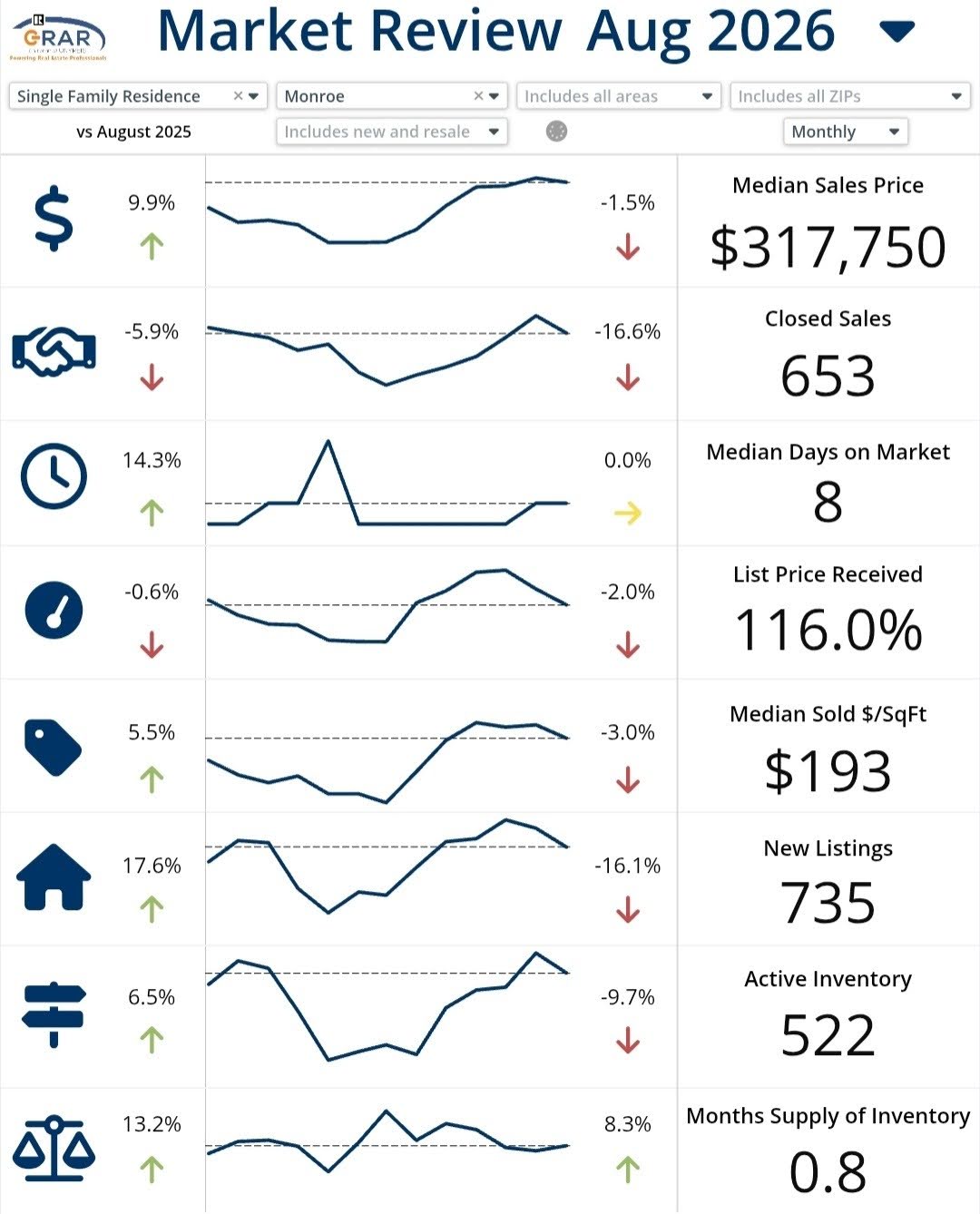
Closed sales continue to fall, but the inventory levels saw their first reversal in a very long time. Compared to the same time last year, active inventory increased 6.5% and listings new to the market jumped 17.6%. These numbers support what we have been seeing on the ground. Some of the intensity has come out of the market and it makes sense to turn to the demand side of the equation for answers.
Mortgage rates are likely part of that story, but they are not the whole story. Affordability, seasonality, economic uncertainty, available inventory and normal changes in buyer behavior all matter too.
I would not look at August and say 7% rates caused the Rochester market to slow. Higher borrowing costs are just one of the pressures making it harder for some buyers to participate at the same level they could before.
But This Is Still Not a Buyer's Market
This is where the August numbers get interesting.
Despite some signs of cooling, the median sale price for a single-family home in Monroe County increased 9.9% from August 2025.
Listing days on the market was still only eight days. Sellers are receiving 116% of the asking price. Even after inventory increasing, Monroe County still had only 0.8 months of available housing supply.
Those are not the numbers of a soft housing market. They describe a very constrained market that has become somewhat less intense.
How Can the Market Be Cooling and Still Be Competitive?
Demand can weaken without becoming weak.
Think about a simple hypothetical example. If 20 buyers are chasing 10 homes and higher mortgage rates remove five of those buyers, demand just fell 25%.
That is meaningful. But there are still 15 buyers competing for 10 homes.
The pressure eased. The shortage did not disappear.
That is essentially what we need to understand about the Rochester real estate market right now. We do not need record buyer demand to remain competitive because we still have so few homes available relative to the number of people who want them.
Mortgage rates can remove buyers from the market without removing enough buyers to balance it.
All of this shows that the Rochester housing market can be noticeably softer without having the data driven signs of a total market shift.
Where 7% Mortgage Rates Fit In
For an individual buyer, this starts with the payment. Higher rates can mean qualifying for less, choosing a lower price range or deciding that the monthly payment simply does not make sense right now.
Some buyers will adjust. Others will wait. When enough people make those decisions, competition can ease. That can create opportunities for the buyers who remain.
We are seeing some homes sit longer. Inspections and stronger contingencies can be more realistic in certain situations. Again, the market hasn’t shifted, so these conditions are very property specific and not a market wide dynamic.
A well-priced home in a desirable location can attract aggressive competition almost immediately, while another home may sit long enough to give a buyer significantly more leverage.
Looking at the market data only tells you part of the story.
The Next Question Is What Happens If Rates Fall
That leads to the next question.
If rates around 7% are keeping some buyers on the sidelines, what happens if mortgage rates eventually fall enough to bring some of those buyers back?
A lower rate could improve affordability and purchasing power. Rochester would still have to deal with the other side of the equation: housing supply.
If lower rates bring more buyers into a market that still has less than one month of available inventory, competition likely increases significantly again.
That does not mean buyers should rush out and purchase a home today. It also does not mean waiting for a lower rate is wrong.
It means waiting has more than one variable. A buyer waiting for lower mortgage rates may not get today's Rochester housing market conditions. Prices, competition, inventory and negotiating leverage can all change too.