


A recent local news update suggested that the Rochester housing market may finally be improving for buyers.
There is some truth to that. Buyers, agents, and lenders have all felt the market become less consistent this spring and summer. One weekend brings heavy competition. The next feels noticeably quieter. Some homes still attract a crowd, while others give buyers more time and flexibility.
There is an important distinction: Buyers can have more opportunity without having more overall market control.
That is what we are seeing right now.
What the July Monroe County Data Actually Shows
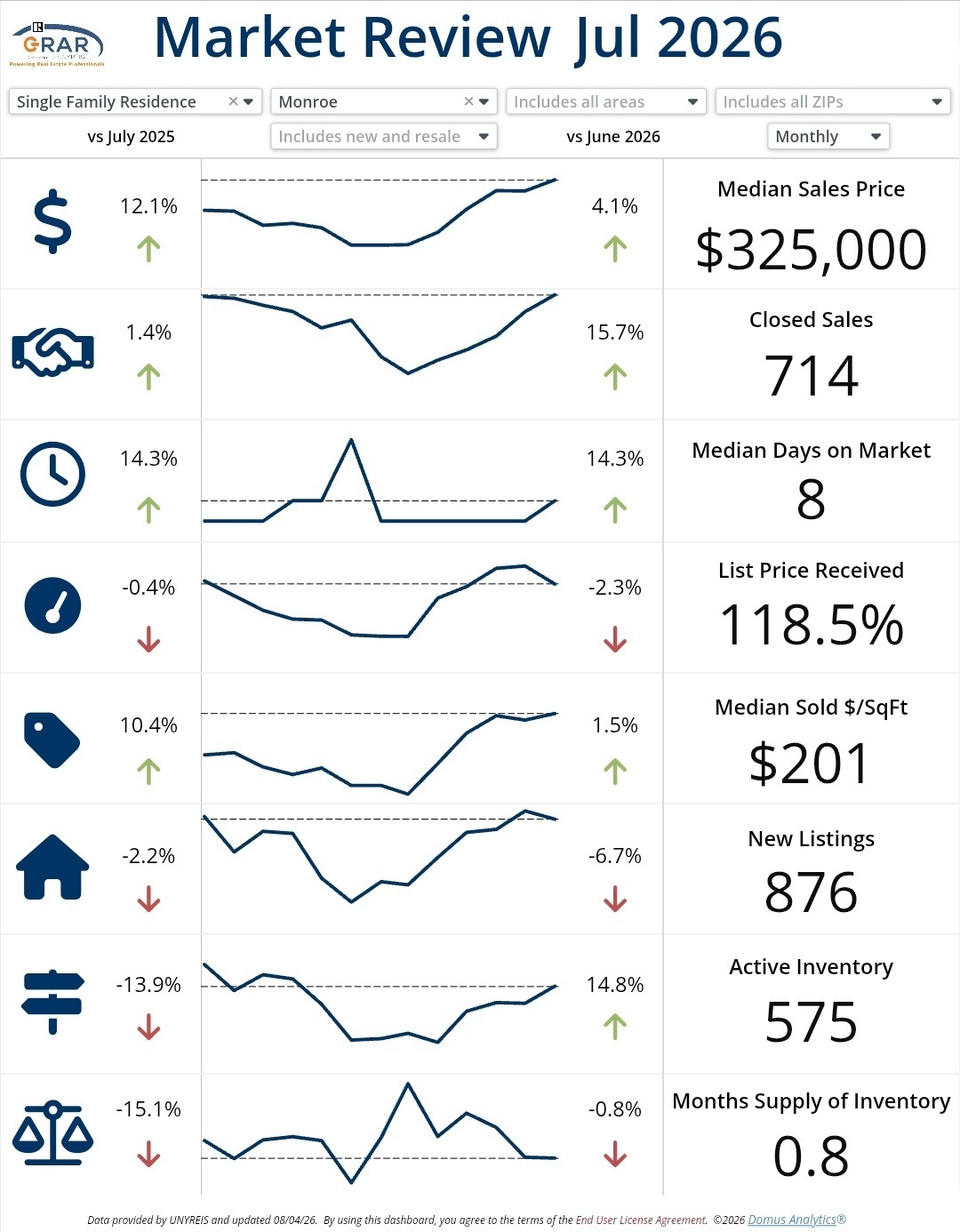
The July 2026 numbers still describe a market that strongly favors sellers overall.
The median sale price for a single-family home in Monroe County reached $325,000, up 12% from July 2025. Active inventory fell to 575 homes, a year-over-year decline of 14%.
Two statistics tell the story especially well:
Monroe County had only 0.8 months of housing supply.
The median home sold for 118.5% of its asking price.
A balanced market normally has 4-6 months of available inventory. Monroe County remains nowhere close to that.
The median home also sold in just eight days. Supply remains extremely limited, prices are still higher than last year, and well-positioned sellers continue to hold substantial leverage.
Buyers Have More Opportunity, but Not More Market Control
Higher mortgage payments, rate movement, inflation pressure and broader economic uncertainty have made buyers more selective. They are paying closer attention to condition, layout, monthly cost and how much work a home may require after closing.
That means two homes in the same price range can produce completely different results.
One may receive multiple offers because it is priced correctly, presents well and feels move-in ready. Another may sit because buyers see too much deferred maintenance, an awkward layout, or a price that gives buyers hesitation.
Buyer selectivity is not the same as demand disappearing. Demand is still there. It is simply more concentrated around the homes buyers believe offer the strongest overall value.
Why the Market Has Felt Inconsistent
If the market has felt difficult to read lately, you are not imagining it.
Demand has moved from week to week throughout much of the spring and summer. Mortgage rates have shifted. Inventory has entered the market unevenly. Vacation schedules, holidays, and school calendars have affected showing activity.
Broader economic uncertainty has added another layer. Higher mortgage rates and inflation pressure, including energy-market disruption connected to the Iran conflict, have contributed to hesitation among some buyers. No single factor has changed the entire market, but together they have made activity harder to predict from one weekend to the next.
Keep in mind that market data each month reflects closings that came from offers accepted several weeks earlier.
The first week of August gives us a more current pulse, and so far it feels very competitive again. We could still see an end-of-summer push before Labor Day as some households try to move before school schedules fully settle in, but one week is not enough to declare anything permanent. This market needs to be evaluated week by week.
One quiet weekend does not mean demand is gone. One heavily contested listing does not mean nothing has changed.
What “Improving for Buyers” Really Means
Improvement does not necessarily mean cheaper.
For some Rochester buyers, improvement may mean facing fewer offers on a particular home, having a better chance of including an inspection, or finding more seller openness to FHA or VA financing.
It may mean getting another opportunity after a home misses its initial offer deadline. It may mean more negotiating room on a mispriced property or one that needs cosmetic work.
A home that receives a bunch of offers is still a seller-controlled situation. A similar home that remains available after its offer deadline may create a very different opportunity.
What improvement does not automatically mean is lower prices, major discounts, no competition, or a balanced market.
Buyers still need to understand how a home is positioned, how much attention it is likely to receive, and what they are comfortable doing before the offer conversation begins.
The opportunity is becoming more property specific.
Headlines Describe the Market. They Do Not Make Decisions.
Housing headlines can help explain what is happening, but two buyers can read the same article and reach completely different conclusions based on their financing, price range, preferred location, timing, and the type of property they want.
A buyer focused on a move-in-ready home in one of Monroe County’s most competitive price ranges may still face significant competition. Another buyer who is open to cosmetic updates, a different town, or a home that has been sitting longer may find more flexibility.
The headline is the starting point. The property and the buyer’s situation determine the strategy.
What Rochester-Area Sellers Should Take From This
We covered local inventory dynamics earlier this year.
Low inventory is still working in a seller’s favor, but today’s buyers are less willing to excuse poor pricing, weak presentation,n or obvious deferred maintenance.
Buyers are still competing for the right homes. They are simply passing more quickly on the ones that do not feel worth the payment or the work.
That makes pricing, preparation, photography, showing access, and first-week execution especially important. Sellers should watch early showing activity and buyer feedback closely instead of assuming limited inventory guarantees the result they want.
The market remains favorable. It just no longer rewards every listing equally.
The Mortgage-Rate Wild Card
Higher mortgage rates have likely held some buyers back.
If rates eventually move lower, more buyers could return before inventory improves. That may increase showing activity and competition for the same limited number of homes.
A lower rate could improve the monthly payment while also making the buying experience more competitive.
The dynamic between rates, affordability,y and competition should be considered when comparing buying now vs. waiting.
Strategy Matters More Than the Headline
The Rochester market is not suddenly easy for buyers, and it is not becoming unfavorable for sellers.
It is becoming more property-specific, more price-sensitive, and more dependent on timing.
Buyers should look for openings instead of waiting for the entire market to change. Sellers should recognize that limited inventory does not guarantee every listing the same result.
This is not a market where one headline gives every buyer or seller the answer. The property, the price, the timing, and the strategy still decide what happens next.