


Mortgage rates around 7% have made buying a home more expensive. So when a Rochester buyer tells me, “I’m going to wait until rates come down,” I understand the thinking.
A lower rate could reduce the monthly payment and improve purchasing power. That is a real benefit.
The bigger question is: What else could change in the Rochester housing market when rates fall?
We do not know when rates will fall, how far they will fall or what the market will look like when they do. This is not a rate forecast. It is a look at how the pieces fit together.
First, Look at What Lower Rates Do to the Payment
Let’s start with the math.
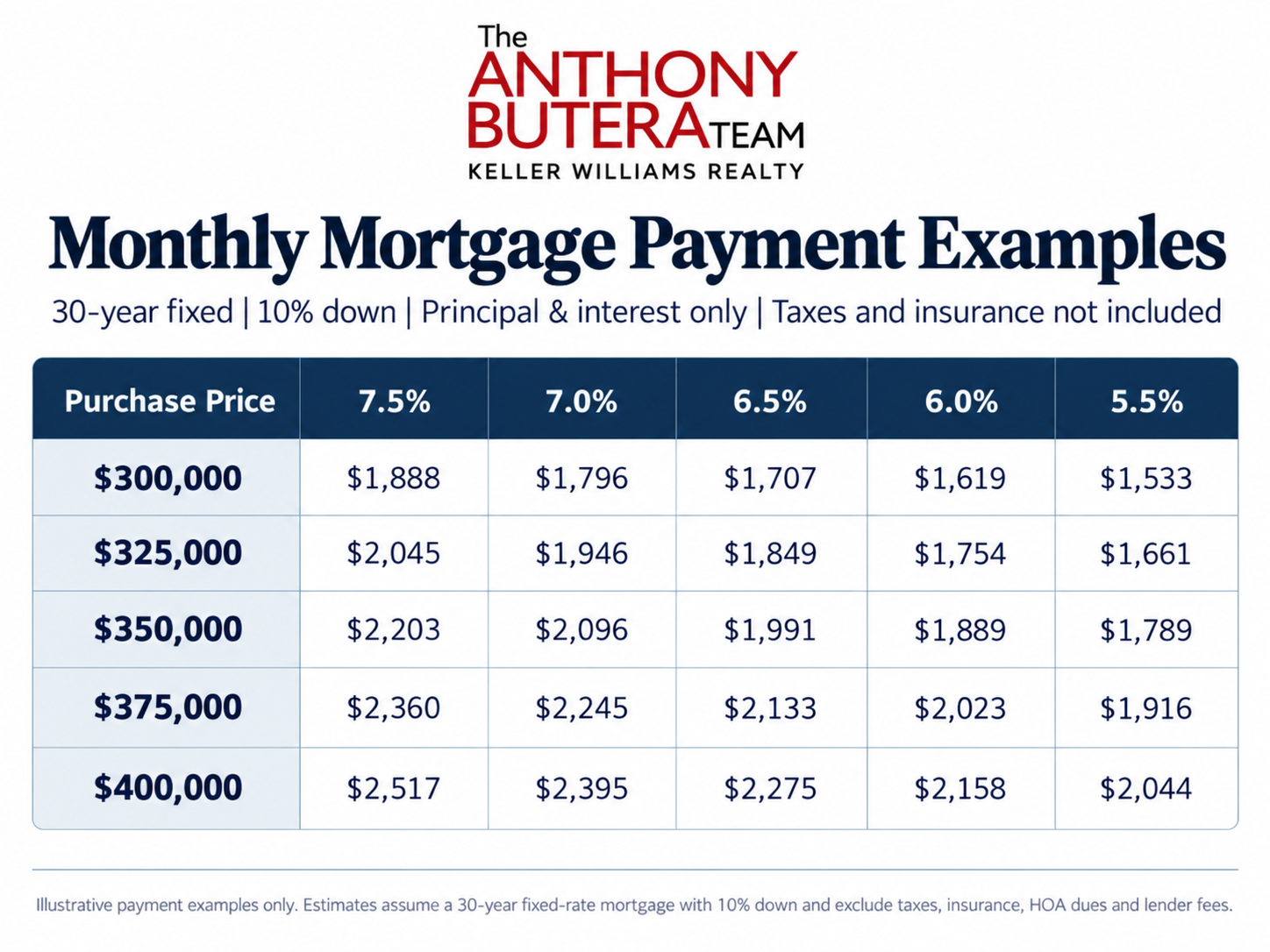
Using a $350,000 purchase, 10% down and a 30-year fixed mortgage, the approximate monthly principal and interest would be:
7.0%: $2,096
6.5%: $1,991
6.0%: $1,889
5.5%: $1,789
Moving from 7% to 6% saves about $207 per month. Which is certainly a big difference for many household budgets.
These examples isolate principal and interest. Property taxes, homeowners insurance and other housing costs still affect the total monthly payment.
If you want the deeper explanation of what moves mortgage rates, we covered that separately in What Determines Your Mortgage Rate?
Lower Rates Also Increase Purchasing Power
A lower payment is only part of the benefit. Lower rates can allow a buyer with the same monthly budget to afford a higher purchase price.
Earlier this year, Redfin illustrated this using a $3,000 monthly housing budget. At a 6.9% mortgage rate, its example buyer could afford about $446,000. At 5.99%, that increased to $479,750. That is $33,750 of additional purchasing power from the rate difference alone.
That is meaningful, but your purchasing power is not the only potential change and it is important to consider what would happen across the entire market.
Lower Rates Could Bring More Buyers Back
This is where the Rochester conversation gets more complicated.
Zillow found that engaged home shoppers were up about 21% year over year this spring, while completed sales increased only 4.5%. Zillow pointed to elevated borrowing costs and affordability pressure as reasons some of that shopping activity had not translated into purchases. Tough to say if this is a definitive sign that more buyers are waiting to purchase because of higher rates, but it is worth considering.
That does not mean everyone sitting on the sidelines immediately buys a house when rates fall. Better affordability could make buying realistic again for some people who are currently priced out, waiting or simply uncomfortable with the payment.
A lower mortgage rate improves your purchasing power. It can improve everyone else’s purchasing power too.
That Matters More in Rochester Because Supply Is Still Tight
This would be a different conversation if Rochester had a large supply of homes waiting for those buyers. We do not.
Our latest Monroe County single-family data showed only 0.8 months of supply. Homes are selling in eight days, sellers received 116% of asking price, and the median sale price was up 9.9% from a year earlier.
Realtor.com’s August 2026 Hotness Index provides some outside context. Rochester ranked #6 nationally, with listings receiving 2.4 times the national average number of views per property.
In our previous article, we talked about how mortgage rates around 7% appear to be removing some demand without removing enough demand to balance the Rochester market.
The same relationship matters in reverse. If affordability improves while supply remains this constrained, stronger buyer participation could increase competition.
There is another side to that. Lower rates could also make some homeowners more comfortable selling, potentially adding inventory. We do not know whether additional demand or additional supply would move more.
That is part of the point. Mortgage rates are only one variable.
Waiting for a Lower Rate Does Not Mean Everything Else Stays the Same
It is easy to picture waiting like this:
Today: 7% mortgage rate
Later: 6% mortgage rate
Everything else: unchanged
Real markets do not work that neatly.
While rates change, so can home prices, inventory, the number of buyers, competition, inspections, contingencies and seller negotiating power. The actual homes available for sale will be different too.
Waiting for a lower mortgage rate is not necessarily waiting for today’s housing market with a cheaper mortgage. That is not an argument against waiting. It is simply part of what a buyer should consider.
What If the Rate Falls but the Price Changes Too?
Go back to the same payment example.
With 10% down:
$350,000 at 7% = $2,096/month
$350,000 at 6% = $1,889/month
$375,000 at 6% = $2,023/month
$400,000 at 6% = $2,158/month
These are hypothetical principal-and-interest examples, not a prediction that a $350,000 home will become a $375,000 or $400,000 home. The point is to test how the variables interact.
At $375,000 and 6%, the payment is still slightly lower than $350,000 at 7%. At $400,000, the higher purchase price more than offsets the benefit of the lower rate.
Interest rate alone does not determine affordability. Purchase price matters too.
So Is It Better to Buy Now or Wait?
There is no single answer.
Waiting can make complete sense if today’s payment is uncomfortable, more savings are needed, credit improvement could materially change the financing, debt needs to come down, employment is uncertain or the right home simply has not appeared.
A future lower interest rate is not a reason to take on a payment that does not make sense today. Buying today is not automatically better simply because competition could increase later either.
The decision has to work with your finances, timeline and comfort level.
Know What You Are Actually Waiting For
Instead of stopping at, “I’m waiting for rates to fall,” make the plan more specific.
What rate are you waiting for? How much would it actually change your payment? What price range works comfortably today? What would need to change financially before buying makes sense?
Then consider the other side of the equation: What could happen to prices, inventory and competition while you wait?
You do not need to predict those answers. You just need to include them in the decision.
A lower mortgage rate would improve the financing side of buying a home. It cannot guarantee a lower home price, more homes to choose from, less competition or better negotiating leverage. It also does not guarantee those things will get worse.
Mortgage rates will change. So will the Rochester housing market.
If waiting is the right decision for your finances or your life, waiting can make perfect sense. Just remember that when mortgage rates eventually fall, the payment may not be the only thing that changes.
The goal is not to predict the market perfectly. It is to understand the variables well enough to make a decision that works for you.